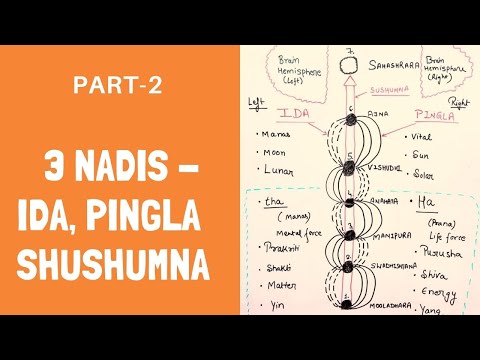
Nadis — The Energy Channels
Nadis are not blood vessels. They are not nerves in the anatomical sense. They are channels of prana — the life-force that flows through the subtle body, the energy body that interpenetrates and animates the physical one. The texts cite 72,000 nadis in total. Three are primary. Everything else in pranayama, mudra, and bandha is in service of understanding — and working with — these three.
Modern physiology now confirms what yogis observed through direct experience: the left nostril activates the right brain, the right nostril activates the left, and the body naturally alternates between them every 90–120 minutes. The nasal cycle is the breath-body interface made visible.
Every 90 to 120 minutes, without you deciding anything, your body switches which nostril is dominant. Left becomes right. Solar becomes lunar. Left-brain sharpness gives way to right-brain receptivity. Then, a few cycles later, it crosses back.
This is the ultradian rhythm — a basic biological oscillator that exists in all humans. Yogis in the Swara Yoga tradition mapped this oscillation in minute detail — predicting from the current nostril dominance what activities would be auspicious, what states of mind would arise, even what dreams would come. Modern rhinometry (airflow measurement in the nostrils) confirmed the cycle's existence and its correlation with EEG-measured brain hemisphere alternation.
The transition moment — when neither nostril is dominant, when both flow equally — is called Sandhi (the junction). In Swara Yoga, this is considered the most powerful moment: Sushumna briefly opens. Traditional texts say the Sandhi lasts only a few minutes. Shambhavi Mahamudra and Nadi Shodhana are technologies for extending and deepening that Sandhi.
Raags are not played at specific times by arbitrary convention. The time of day determines which nadi is dominant — which brain hemisphere is active — which quality of attention is available. The raag is matched to the pranic state of the listener. Music and breath share the same underlying grammar.
The pre-dawn hour (Brahma Muhurta) is when the nasal cycle naturally shifts — many people experience both nostrils equally open near 4–5 AM. Bhairav's komal Re andolan mimics the slow oscillation of breath that characterises this Sushumna moment. The devotional stillness of Bhairav is the sound of neither-nor.
Dusk is when the body shifts from the active solar day (Pingala dominance) toward the receptive lunar evening (Ida). Yaman's tivra Ma — the raised fourth, the longing note — captures the quality of this transition: the day's activity is not yet over, but the evening's receptivity has begun. The raag moves outward (like Pingala) but in a longing, yearning way that already belongs to Ida.
Midnight is the depth of Ida dominance — the most lunar hour, the most inward, the most cooling. Malkauns's absence of Pa (the dominant) removes all outward urgency — Pingala has completely quieted. The three komal swaras are all soft, inward notes. The raag's tantric depth is the sound of pure Ida: the body returned to earth, the mind below thought.
The traditional instruction: before sitting to play or listen to a raag, check which nostril is open. If it matches the raag's nadi, proceed — the system is aligned. If not, practice a few rounds of Nadi Shodhana until balance arrives, or lie briefly on the appropriate side to open the correct nostril. Music received in the correct pranic state lands differently than music received in misalignment.
Nadi Shodhana is the most important single pranayama for nadi work. By alternating breath between left and right nostrils in a specific rhythm, it directly balances Ida and Pingala — and in doing so, creates the conditions for Sushumna activation. It is both the preparation for deeper practices and a complete practice in itself.
Sit with spine erect. Bring right hand to the face — ring finger and little finger over the left nostril, thumb over the right. Index and middle finger rest between the eyebrows at Ajna.
Close the right nostril with the thumb. Inhale slowly through the left — as slow and deep as possible. This is Ida activation: the left channel fills.
Close both nostrils briefly at the top of the inhale. Then open the right nostril and exhale slowly and completely. Pingala empties.
Inhale through the right nostril. Pingala fills. Close both briefly. Open the left nostril. Exhale through the left. Ida empties. This completes one round.
Continue for 5–15 minutes. The breath should grow slower with each round — not forced, but finding its natural floor of ease.
After the final round, sit in stillness with both nostrils open. This is the Sandhi — the junction. Do nothing. Let whatever arises, arise.
The three principal channels — Ida (lunar/left), Pingala (solar/right), and Sushumna (central). Understanding them is the grammar beneath every pranayama.